
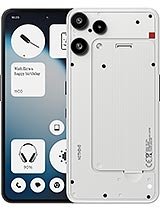
👍 Pros
- The 120Hz AMOLED display with high peak brightness offers a visually fluid and vibrant user experience, especially for media consumption.
- A 5000 mAh battery capacity, combined with 33W wired charging, suggests substantial endurance and reasonably quick top-ups.
- The inclusion of microSDXC expansion is a practical advantage for users requiring flexible storage options.
👎 Cons
- The Mediatek Dimensity 7300 Pro, while 4nm, is a mid-range chipset from late 2025, which by late 2026 places it a generation behind current performance expectations for demanding tasks.
- The GPU, Mali-G615 MC2, indicates a lower-tier graphics performance, potentially limiting smooth operation in graphically intensive applications or newer games.
- The 16 MP selfie camera with 1080p@30fps video recording is a modest offering, lacking higher resolution video options or advanced features often found in more premium devices.
Expert Review & Rating
Market Position in 2026
Launched in late 2025, the Nothing Phone (3a) Lite enters the 2026 market as a budget-focused device. Its specifications, particularly the Mediatek Dimensity 7300 Pro chipset, position it squarely in the mid-range segment, aiming to deliver a balanced user experience without the premium price tag. The inclusion of a high refresh rate AMOLED display and a substantial battery capacity are key features designed to attract users looking for value. However, in a rapidly evolving market, its late 2025 processor means it’s already competing against newer, potentially more powerful chipsets by the current year.
Technical Trade-offs
To achieve its competitive price point of around 230 EUR, several technical compromises are evident. The plastic frame, while contributing to weight reduction, might not offer the same perceived durability or premium feel as an aluminum alternative. The Mediatek Dimensity 7300 Pro, while a capable 4nm chip, is a mid-range offering from the previous year. This means users should not expect cutting-edge performance in graphically demanding applications or future-proof processing power for the most intensive tasks. The GPU, Mali-G615 MC2, further reinforces this, suggesting that high-fidelity gaming at maximum settings might not be its strong suit. Additionally, while 33W charging is decent, it’s not the fastest available in 2026, meaning a full charge will still take over an hour. The 16 MP selfie camera, while adequate for basic use, lacks higher resolution video recording options, which could be a limitation for content creators or those prioritizing front-camera video quality.
Hardware & Performance Analysis
Based on the hardware, the Mediatek Dimensity 7300 Pro (4 nm) is a chipset designed for efficiency and balanced performance in the mid-range. Its octa-core CPU, with four Cortex-A78 cores clocked at 2.5 GHz, suggests decent processing power for daily tasks, app navigation, and moderate multitasking. The 4nm fabrication process theoretically contributes to better power efficiency compared to older nodes, which should aid battery life. That being said, the Mali-G615 MC2 GPU indicates that graphically intensive applications and the latest mobile games will likely run at lower settings or frame rates to maintain fluidity. The 8GB of RAM, combined with Android 15 and Nothing OS 3.5, should provide a smooth user experience for typical usage patterns, allowing for several applications to be open concurrently without significant slowdowns. The inclusion of microSDXC support is a practical choice, offering expandable storage beyond the internal 128GB or 256GB, which is a tangible benefit for users with large media libraries.
Strengths on the Spec Sheet
The Nothing Phone (3a) Lite presents a few notable strengths on its spec sheet that are particularly compelling for its price category. Firstly, the AMOLED display stands out. With a 6.77-inch size, 120Hz refresh rate, 1 billion colors, and impressive peak brightness of 3000 nits (1300 nits HBM), it promises a vibrant, smooth, and highly visible viewing experience even in bright outdoor conditions. This is a significant advantage for media consumption and general UI fluidity at this price point. Secondly, the 5000 mAh battery capacity is substantial. This large battery, coupled with the efficient 4nm chipset, should translate into excellent battery life, potentially lasting a full day or more for most users. The 33W wired charging, while not class-leading, is still reasonably fast, capable of achieving 50% charge in 20 minutes, which is a practical benefit for quick top-ups. Lastly, the inclusion of a microSDXC card slot provides valuable flexibility for storage expansion, allowing users to augment the internal 128GB or 256GB as needed without relying solely on cloud services.
Buying Advice & Verdict
Considering it’s late 2026, the Nothing Phone (3a) Lite, launched in late 2025, is now a year old. Its Mediatek Dimensity 7300 Pro chipset, while competent for its original price, is now a generation behind. This means that while it will handle everyday tasks and lighter gaming adequately, it won’t offer the same performance headroom as current-year devices, especially for demanding applications or future OS updates beyond its promised three major updates. For its estimated price of around 230 EUR, it still offers a strong display and battery life. Yet, if performance for gaming or heavy multitasking is a priority, newer alternatives in the same price bracket might offer more up-to-date chipsets. If you can find this phone significantly discounted, perhaps in the used market, its display and battery could make it a compelling budget option for users prioritizing media consumption and basic smartphone functions over raw processing power. Otherwise, for new purchases at its original price, it’s worth exploring newer models with more current chipsets.
Frequently Asked Questions (FAQs)
While the display and battery are strong, the main trade-offs are in the processor and camera. The Dimensity 7300 Pro, being a late 2025 mid-range chip, won't compete with 2026's latest, especially in graphics. Also, the plastic frame, while functional, isn't as premium as metal, and the selfie camera is fairly basic in terms of video capabilities.
The 50 MP main sensor with a relatively large 1/1.57" sensor size and 1.0µm pixels, along with dual pixel PDAF, suggests it's capable of decent photos in good lighting. For social media, it should perform well. However, without specific details on optical image stabilization (OIS) for the main sensor, and given the mid-range nature of the device, its low-light performance for night photography might be limited compared to phones with dedicated OIS or more advanced computational photography features. The 8 MP ultrawide and 2 MP macro are standard additions, useful but not exceptional.