
👍 Pros
- Retina LTPO OLED display with 1000 nits peak brightness ensures excellent visibility in various lighting conditions.
- Robust build quality featuring sapphire crystal glass and a ceramic/titanium frame, offering enhanced durability and scratch resistance.
- Comprehensive cellular connectivity (GSM, HSPA, LTE) for standalone usage.
- ECG certification provides advanced heart health monitoring capabilities.
👎 Cons
- The Apple S5 processor, while capable at its release, is significantly underpowered compared to 2026 smartwatch chipsets, potentially leading to slower performance and app loading times.
- Battery life of approximately 18 hours is considerably below the multi-day endurance expected from premium smartwatches in 2026, necessitating frequent charging.
- The 32GB internal storage, while adequate for its time, is limited for extensive app installations and media compared to contemporary devices.
- Discontinued status means lack of ongoing official support and potentially limited access to the latest software features and security updates.
Comprehensive Review & Rating
Detailed Analysis
Design & Build
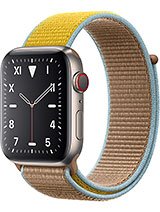
The Apple Watch Edition Series 5, released in 2019, showcases a premium construction that remains commendable even in 2026. Its sapphire crystal front and ceramic/titanium frame offer superior scratch resistance and durability compared to standard smartwatch materials. The 50-meter water resistance further enhances its utility for various activities. Despite its age, the physical design maintains a classic Apple aesthetic, though its dimensions are now considered standard rather than compact.
Display & Performance
The 1.78-inch Retina LTPO OLED display with 1000 nits peak brightness was groundbreaking at its launch, providing excellent readability and vibrant colors. The Always-On functionality was a significant innovation. However, in 2026, while the display quality remains good, the Apple S5 SiP processor is a notable bottleneck. Modern smartwatch applications and watchOS iterations demand more processing power, and users may experience slower app launches, less fluid animations, and reduced responsiveness compared to contemporary devices. The 32GB internal storage, while sufficient for basic use, limits the capacity for extensive music libraries or numerous third-party applications.
Health Tracking & Battery
The health tracking suite of the Apple Watch Edition Series 5, including an ECG sensor, heart rate monitoring, and activity tracking, was comprehensive for its era. These core functionalities remain relevant in 2026, providing valuable health insights. However, newer smartwatches often integrate more advanced sensors such as blood oxygen saturation (SpO2) and skin temperature, which are absent here. The battery life, rated at approximately 18 hours from its 296 mAh capacity, is a significant drawback when evaluated against 2026 standards. Most premium smartwatches today offer multi-day battery endurance, making the Series 5’s daily charging requirement a notable inconvenience for modern users.
Final Verdict
In 2026, the Apple Watch Edition Series 5 presents a complex proposition. Its premium build materials and excellent display still hold up, and its core health tracking features remain functional. However, the outdated Apple S5 processor and particularly the limited battery life are considerable compromises when compared to current-generation smartwatches. The discontinued status also implies a lack of future official support. For users seeking a highly durable and aesthetically pleasing smartwatch for basic notifications and health tracking, and who are comfortable with daily charging, a pre-owned Series 5 might be a cost-effective option. However, for those prioritizing cutting-edge performance, extended battery life, and the latest health sensors, investing in a more contemporary model is advisable.
Frequently Asked Questions (FAQs)
💡 While its premium build and display remain competent, the Apple S5 processor and 18-hour battery life are significantly outdated compared to 2026 standards, impacting performance and daily usability.
💡 Yes, it includes an ECG sensor, heart rate monitor, and activity tracking. However, it lacks some newer sensors like SpO2 and skin temperature found in more recent smartwatches.
💡 The main limitations are its comparatively slow processor, requiring more frequent charging due to its limited battery life, and its discontinued status which affects long-term software support.